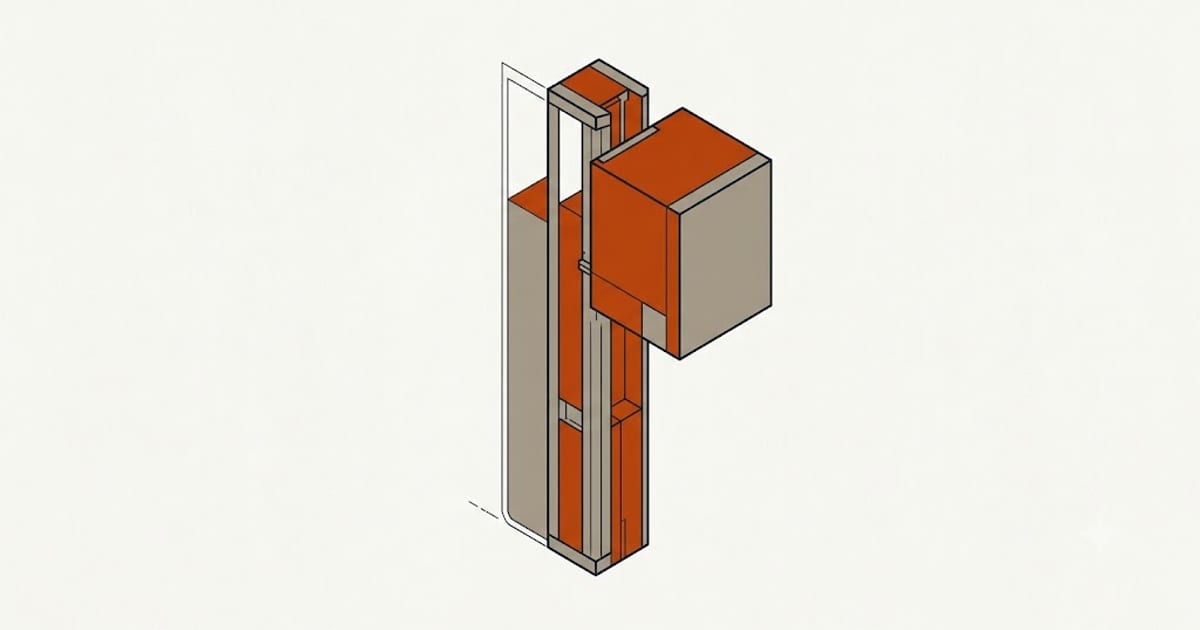
Home charging is the largest single electrical load most households add, and it is the reason service upgrades are being quoted on houses that were adequate for decades.
Levels
Level 1 — a standard 120 V receptacle. Adds a few miles of range per hour. Requires nothing new, and for a household driving modest distances it is genuinely sufficient.
Level 2 — 240 V, typically 30 to 60 amps. Adds tens of miles per hour and is what most people mean by a home charger.
DC fast charging is commercial equipment and does not appear at houses.
The circuit
EV charging is a continuous load — it runs for three hours or more at its rated current.
Continuous loads are sized at 125% of the load, so:
| Charger output | Circuit |
|---|---|
| 24 A | 30 A |
| 32 A | 40 A |
| 40 A | 50 A |
| 48 A | 60 A |
A 48 amp charger on a 60 amp circuit is the common maximum for a residential wall unit, and it is also the one most likely to force a service upgrade.
Hardwired or plug-in
A plug-in unit on a 14-50 receptacle is limited to 40 amps of continuous draw and can be unplugged and taken to another house.
A hardwired unit can go higher and is generally required for the largest chargers. Receptacles supplying EV equipment now also carry GFCI requirements in many jurisdictions, and the interaction between a charger's own internal protection and an upstream GFCI is a known source of nuisance tripping — worth raising with the installer.
The capacity question
Adding 48 amps of continuous load to a 100 amp service is usually not possible without something else changing.
The Code recognises several answers, and they are much cheaper than an upgrade:
Load management — a device that monitors the service and reduces or interrupts charging when the rest of the house is drawing heavily. This is explicitly permitted and it is how most constrained houses solve it.
A smaller charger. A 24 or 32 amp unit charging overnight replaces far more range than most households use in a day. The step from 32 to 48 amps buys speed that is rarely needed at home.
Charging on a schedule, outside the household's peak, which also usually costs less per kilowatt-hour on a time-of-use tariff.
A meter socket adapter or a service-integrated system that manages the whole house.
What actually gets quoted
An electrician asked for "an EV charger" frequently quotes a 60 amp circuit and, on a 100 amp service, a service upgrade to go with it.
That is a correct answer to the question asked. Asking instead for the smallest arrangement that meets the household's actual daily mileage, with load management if needed, usually produces a much smaller number.
The other things worth doing at the same time
Run conduit or a larger raceway than currently needed, so a future upgrade is a pull rather than a dig.
Consider a second vehicle, since two chargers on one managed circuit is a common and well-supported arrangement.
Check for incentives. Utility and state programmes frequently fund part of the equipment or the installation, and some fund load management devices specifically.
The load calculation
Required for a permit in most jurisdictions, and it is the document that determines whether an upgrade is genuinely needed.
Ask for it in writing with the individual loads listed. It is the difference between a quote that reflects the house and one that reflects a default.