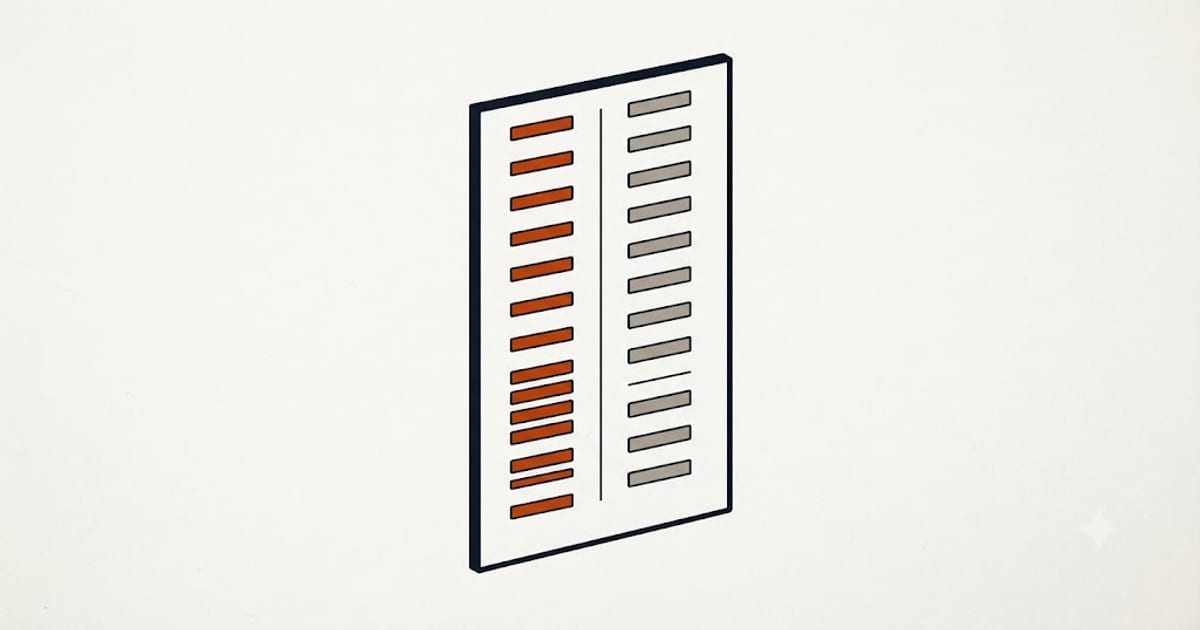
Tandem breakers — two circuits in the space of one — are not a loophole and not a violation. They are a listed product, and whether you may use them is a property of your specific panel, stated on the label inside the door.
That is why every confident general answer on the internet is wrong for somebody. Read the label.
What the label tells you
Every residential panel carries a label giving the maximum number of circuits and the number of spaces. A panel described as "20 space, 40 circuit" is telling you plainly that it is listed for tandems in every position. One marked "20 space, 20 circuit" is telling you it is not listed for any.
Between those, most panels allow tandems only in specific positions, and the label shows which — usually as a small diagram of the bus with the permitted positions marked, often the lower ones.
CTL, and why some tandems physically will not fit
Since the 1960s, panels have been built with circuit total limitation. The bus stabs in positions where tandems are not permitted are shaped so that a standard tandem cannot mechanically seat on them. This is deliberate: the manufacturer enforces its own listing with metal rather than trusting a label to be read.
There are also CTL-rejecting tandems designed for particular panels, and non-CTL tandems intended for replacement in older equipment. Fitting a non-CTL breaker into a CTL position to defeat the rejection feature is exactly the thing the design exists to prevent, and it is the one genuinely unsafe version of this question.
The reason it matters is heat. The bus assembly, its spacing and its ability to shed heat were tested with a defined number of circuits. Exceeding it puts more current through the same busbar in the same enclosure, and busbars fail by overheating at the stab connection — slowly, invisibly, and eventually by arcing.
Brand matters more than people expect
Tandem breakers are not interchangeable between manufacturers, and using the wrong one is not a technicality — the stab geometry and the interrupting rating differ. A breaker that clips in and looks right can be a poor connection that heats.
Use the breaker the panel manufacturer lists for that panel. The listing is a tested combination, not a preference.
Where tandems are not permitted regardless
Where a 240-volt circuit is needed. A tandem is two independent single-pole breakers, and in most types both poles are on the same leg of the bus. That gives no voltage between them. A double-pole breaker spans two legs; it looks similar and does something completely different.
Where AFCI or GFCI protection is required. Combination tandems with built-in AFCI or GFCI exist for some panels, but they are not universal, and where the required protection is unavailable in tandem form the circuit needs a full space.
Where handle ties are required for a multi-wire branch circuit. Two circuits sharing a neutral must be able to be disconnected together, and they must be on opposite legs — a tandem generally satisfies neither.
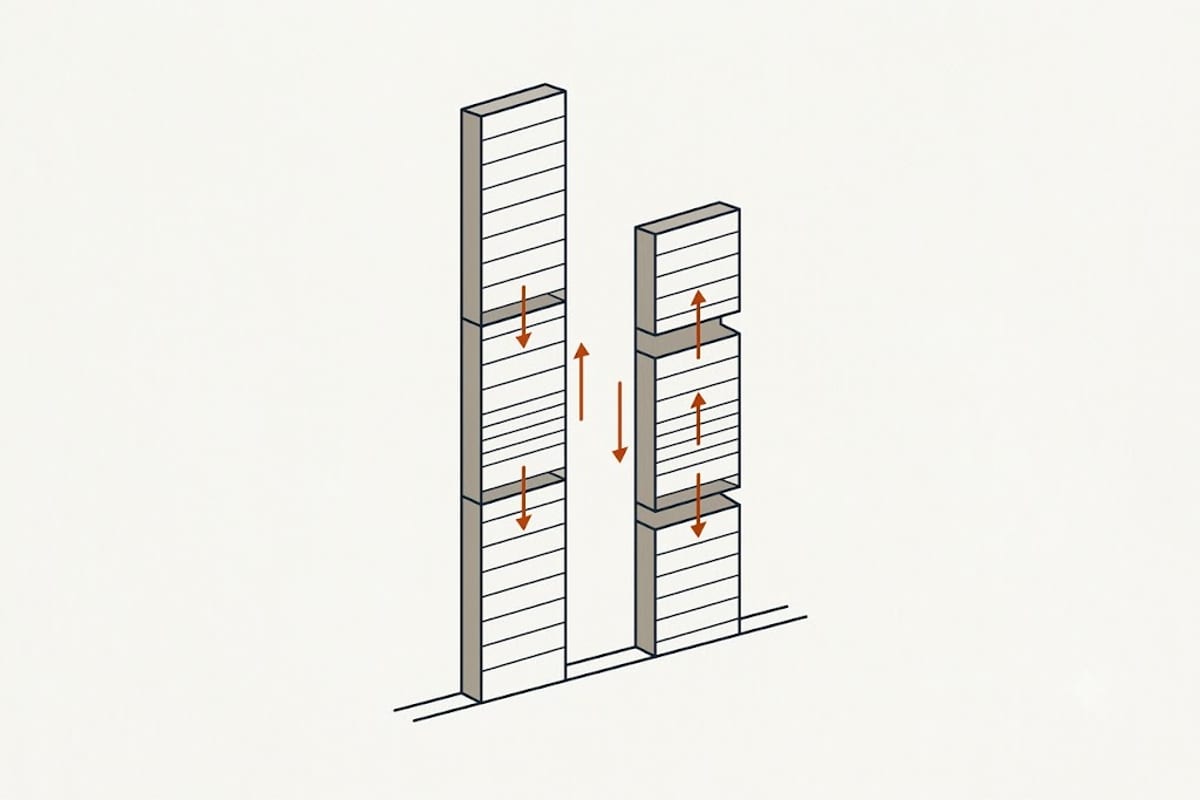
Slots are not circuits, which is the other half of the problem
The reason people reach for tandems is that the panel filled up faster than expected, and the usual cause is arithmetic:
Every two-pole breaker takes two slots. Range, dryer, water heater, air conditioner, EV charger. A house with five two-pole breakers uses ten slots for five circuits. This is why a "40-space" panel routinely fills up at circuit 28, and why counting circuits when buying a panel is the wrong count.
When the right answer is a subpanel
Tandems solve a shortage of spaces. They do nothing about a shortage of capacity, and the two get confused constantly.
If the panel is full but the calculated load is comfortably within the service, tandems where listed, or a small subpanel, both work — and a subpanel is often the better answer because it leaves room for the next thing.
If the calculated load is at or over the service rating, no arrangement of breakers helps. That is a service upgrade, and adding circuits to a panel that is already at capacity simply distributes the same overload across more wires.
The three-step version
- Open the panel door and read the label: spaces, maximum circuits, and which positions accept tandems.
- Count your slots, remembering every two-pole breaker takes two.
- If you need capacity rather than space, stop counting breakers and do a load calculation.