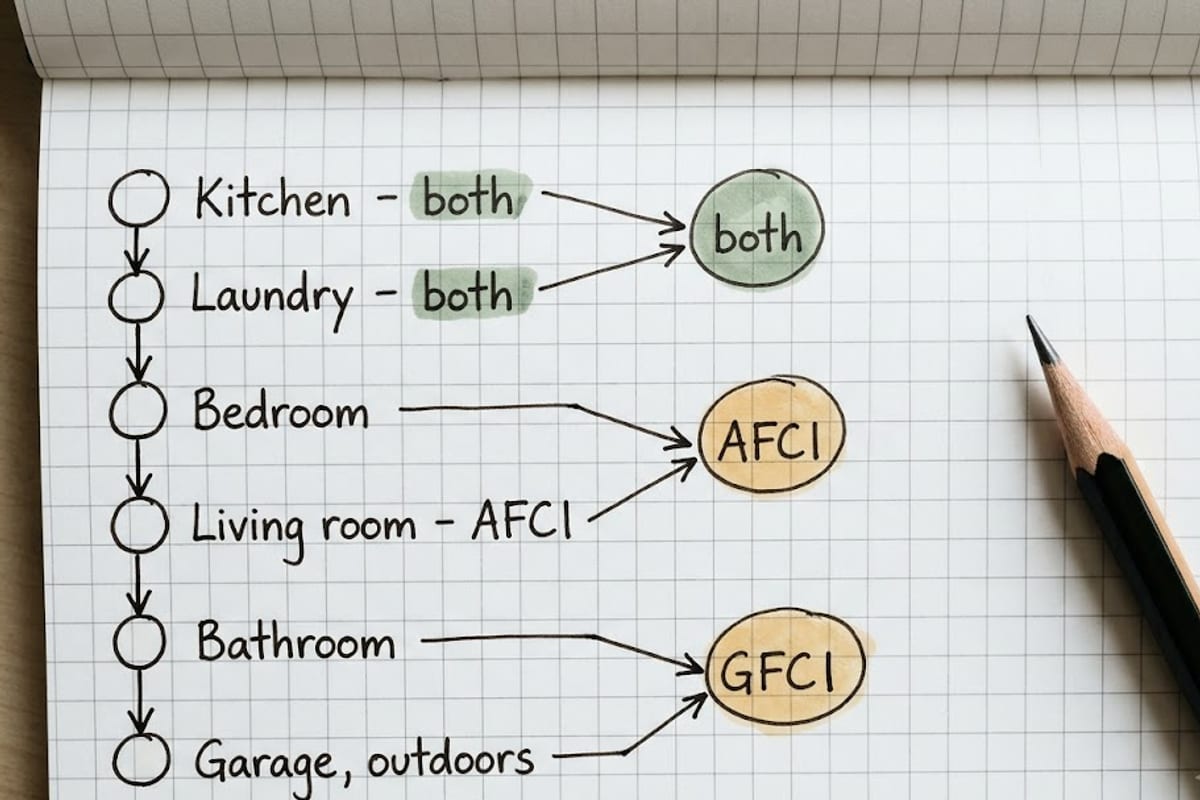
GFCI (ground-fault circuit interrupter) protection is required where people can get a shock through water or the ground: bathrooms, kitchens, laundry areas, garages, basements, outdoors, and near sinks. AFCI (arc-fault circuit interrupter) protection is required on 120 volt, 15 and 20 amp circuits in almost every living area of a house: bedrooms, living and family rooms, kitchens, dining rooms, hallways, closets and laundry areas. Kitchens and laundry areas need both, and a dual-function breaker covers both on one device.
The rules below follow the 2023 National Electrical Code. States and cities adopt code editions on their own schedules and often amend these two sections, so check which edition your jurisdiction enforces.
What each device protects against
GFCI compares the current going out on the hot conductor with the current coming back on the neutral. If they differ by about 5 milliamps, some current is leaking through something else, possibly a person, and the device trips in a fraction of a second. It protects people from electrocution. It does nothing about fires from arcing.
AFCI watches the current waveform for the signature of an arc: a loose connection, a nail through a cable, a cord crushed under furniture. It trips before the arc can ignite surrounding material. It protects the building from fire. It does not provide shock protection.
Where GFCI is required in a house (NEC 210.8(A))
Under the 2023 NEC, GFCI protection is required for receptacles rated 125 through 250 volts, on single-phase circuits of 150 volts to ground or less, in these dwelling locations:
- Bathrooms.
- Garages and accessory buildings with a floor at or below grade used for storage or work.
- Outdoors.
- Crawl spaces at or below grade.
- Basements.
- Kitchens, all receptacles, not only those serving the countertop.
- Areas with sinks and permanent provisions for food or beverage preparation.
- Within 6 feet of the outside edge of any sink.
- Within 6 feet of a bathtub or shower stall.
- Laundry areas.
- Boathouses.
- Indoor damp and wet locations.
The move to 125 through 250 volts means 240 volt receptacles in these locations, such as a dryer receptacle in a laundry room or a range receptacle in a kitchen, now need GFCI protection too. That is usually done with a two-pole GFCI breaker.
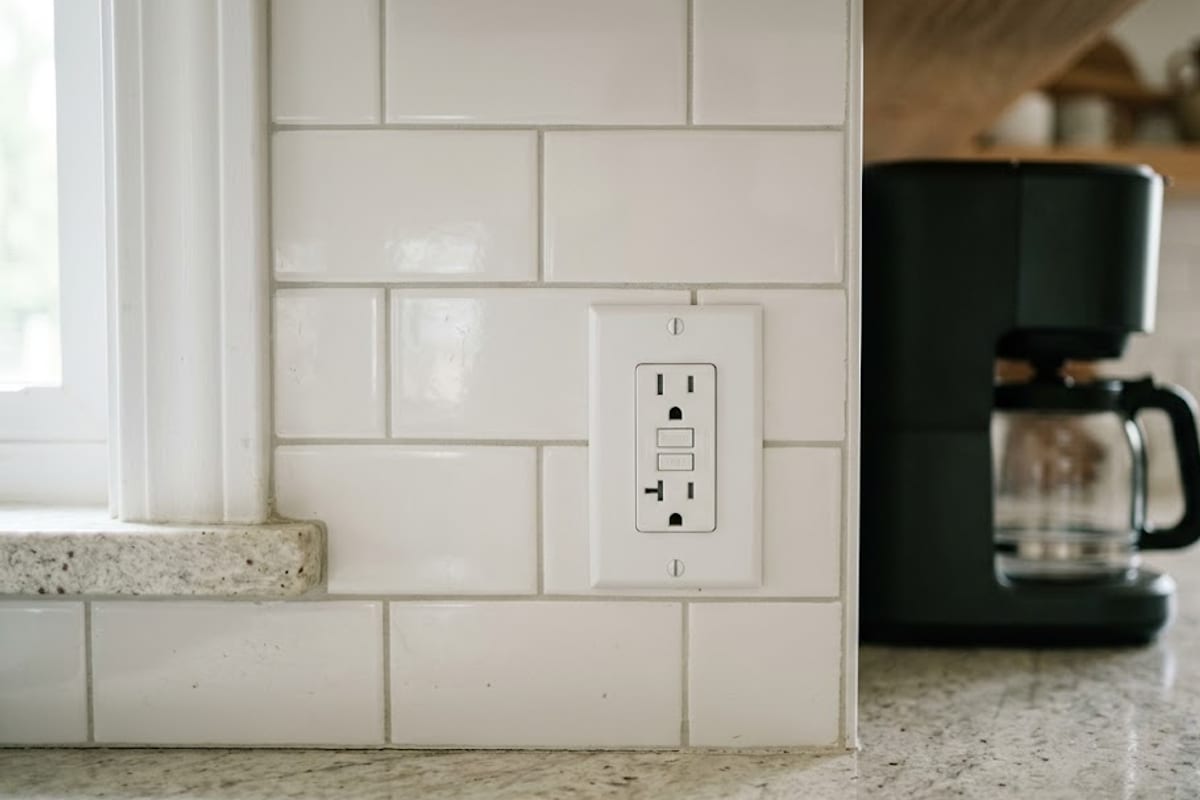
Separate sections add GFCI protection for specific equipment, including dishwashers (210.8(D)) and outdoor outlets up to 50 amps (210.8(F)), which can include an air conditioner or heat pump outdoor unit. Some heat pumps with variable-speed drives have tripped GFCI breakers, and several states amended 210.8(F) for that reason. Ask your electrician how your jurisdiction handles it.
Where AFCI is required (NEC 210.12)
In dwelling units, AFCI protection is required for all 120 volt, single-phase, 10, 15 and 20 amp branch circuits supplying outlets or devices in:
- Kitchens and dining rooms.
- Family rooms, living rooms, parlors, libraries and dens.
- Bedrooms, sunrooms and recreation rooms.
- Closets and hallways.
- Laundry areas.
- Similar rooms or areas.
In practice, that covers nearly every 15 and 20 amp circuit in a house except bathrooms, garages, outdoor circuits and some unfinished basements.
When an older house has to add protection
The rules apply to new work. An existing house does not have to be brought up to date just because the code changed. Protection becomes required when you change something:
- Replacing a receptacle. NEC 406.4(D) requires a replacement receptacle to have GFCI protection if it is in a location that requires GFCI today, and AFCI protection if it is in an area that requires AFCI today. A like-for-like receptacle swap in a kitchen or bedroom can trigger both.
- Extending or modifying a circuit. Under 210.12(D), extending an existing branch circuit in an AFCI area by more than 6 feet, or adding outlets, requires AFCI protection for that circuit.
- Replacing the panel. Many inspectors require circuits moved to a new panel to get AFCI and GFCI breakers where the current code calls for them. Rules vary, so ask before assuming.
Which device to use
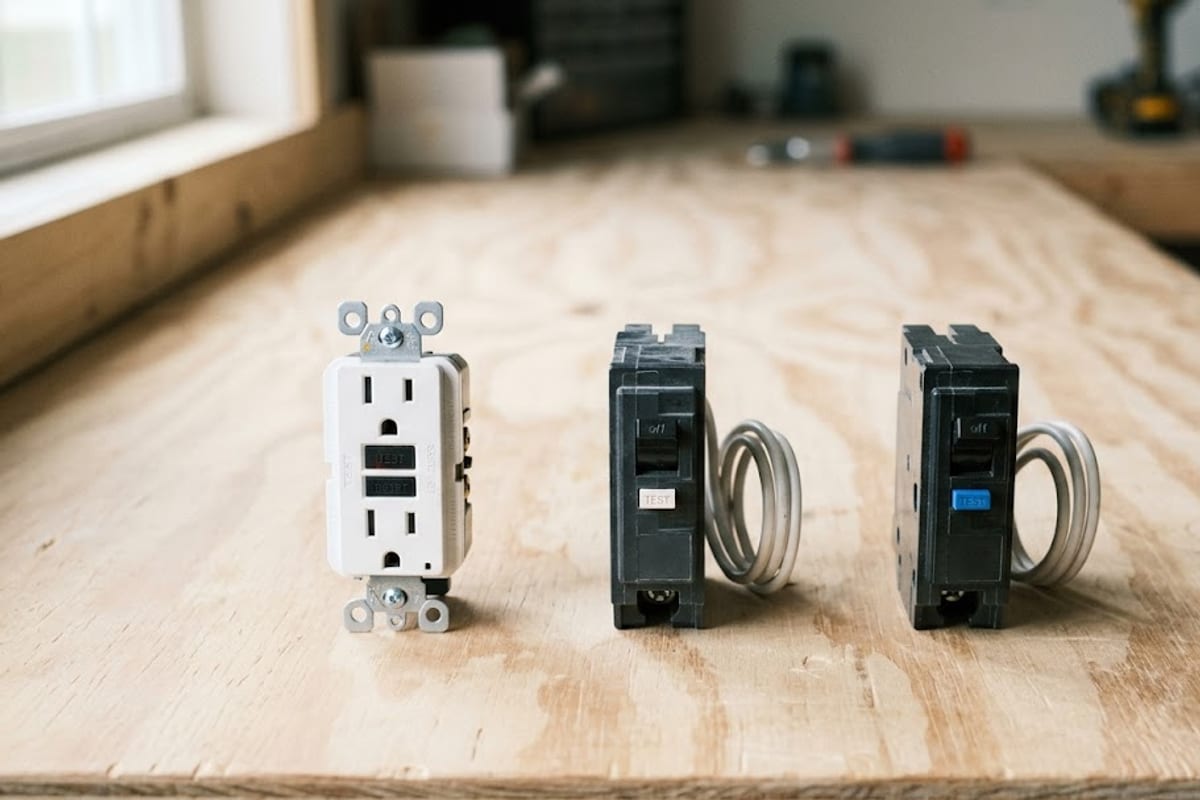
GFCI receptacle. Protects itself and every receptacle wired downstream from its load terminals. Cheaper than a breaker and easy to reset where the problem is. Common in bathrooms and kitchens.
GFCI breaker. Protects the whole circuit from the panel. Useful when the first receptacle is hard to reach, and for 240 volt circuits.
AFCI breaker. The usual way to add arc-fault protection, because it covers the whole circuit including the wiring in the walls. Outlet-branch-circuit AFCI receptacles exist and are allowed in some situations, mainly for older circuits being extended.
Dual-function breaker. Both protections in one breaker. The normal choice for kitchen and laundry circuits, which need both. A 20 amp single-pole dual-function breaker such as Square D's QO120DFC lists for about $80 at Home Depot. Plug-on neutral versions snap onto a neutral rail and skip the pigtail.
Breakers must match the panel brand and series. A QO breaker belongs in a QO panel, a Homeline breaker in a Homeline panel. Using a different brand's breaker, even if it fits, is not allowed unless the breaker is listed for that panel.
What adding protection costs
In an existing house, the cheapest path depends on where the protection is needed. A GFCI receptacle at the first outlet of a bathroom or kitchen circuit protects everything downstream and usually costs $20 to $30 in parts. Breakers cost more but cover the whole circuit. A 20 amp dual-function AFCI/GFCI breaker lists for about $80 at retail, and a panel with twelve circuits in AFCI areas can add $500 to $1,000 in breakers alone.
Older panels complicate this. Some discontinued panel lines have no AFCI or GFCI breakers available at all. In those panels, outlet-branch-circuit AFCI receptacles and GFCI receptacles are the practical option, or the panel is replaced. If you are already considering a panel replacement, price the protective breakers as part of it rather than separately.
Nuisance tripping
AFCI and GFCI devices trip for reasons other than danger, and the cause is usually in the circuit rather than the device:
- Shared neutrals. An AFCI or GFCI trips if the neutral of its circuit is connected to another circuit's neutral, a common condition in older wiring and in multiwire circuits that were not built with a two-pole breaker.
- Neutral touching ground somewhere in a box.
- Motors and old appliances. Older refrigerators, vacuum cleaners and some power tools can produce arc-like signals or small leakage currents.
- Moisture in outdoor boxes or in a damp basement.
- Long runs with normal leakage that adds up.
A breaker that trips once may be doing its job. One that trips repeatedly on the same circuit usually points to a wiring problem that should be traced by an electrician, not solved by swapping in a standard breaker.
Testing
Press the test button about once a month, as manufacturers recommend. The device should trip and cut power. Reset it. A device that does not trip when tested is not protecting the circuit and should be replaced.
Who should do this
Replacing a receptacle with a GFCI receptacle is a common homeowner job where local rules allow it, done with the breaker off and verified with a tester. Installing breakers means working inside the panel, where the main lugs stay energized even with the main breaker off. That work is for a licensed electrician in most jurisdictions.
FAQ
Do bedrooms need GFCI? Not under the 2023 NEC, unless a receptacle is within 6 feet of a sink or in another listed location. Bedrooms need AFCI.
Does a refrigerator need GFCI? In a kitchen under the 2023 NEC, yes, because all kitchen receptacles need it. Some local amendments exempt the refrigerator receptacle.
Can one GFCI receptacle protect a whole bathroom? Yes, if the other receptacles are wired to its load terminals. Label the protected receptacles "GFCI protected."
Why is my kitchen circuit on a breaker with a test button? It is a dual-function breaker, covering both the AFCI and GFCI requirements for kitchens. See kitchen circuit requirements.