A kitchen built to the current National Electrical Code needs at least two 20 amp small-appliance circuits for the countertop receptacles, plus separate circuits for the major appliances. With a range, dishwasher, disposal, over-range microwave, refrigerator and lighting, most kitchens end up with seven to nine circuits. Countertop receptacles must be spaced so no point along the counter wall is more than 24 inches from one, and all kitchen receptacles need GFCI protection.
The details below follow the 2023 NEC. Your jurisdiction may use an earlier edition or local amendments, and appliance manufacturers set their own circuit requirements, which the code tells installers to follow.
The two small-appliance circuits
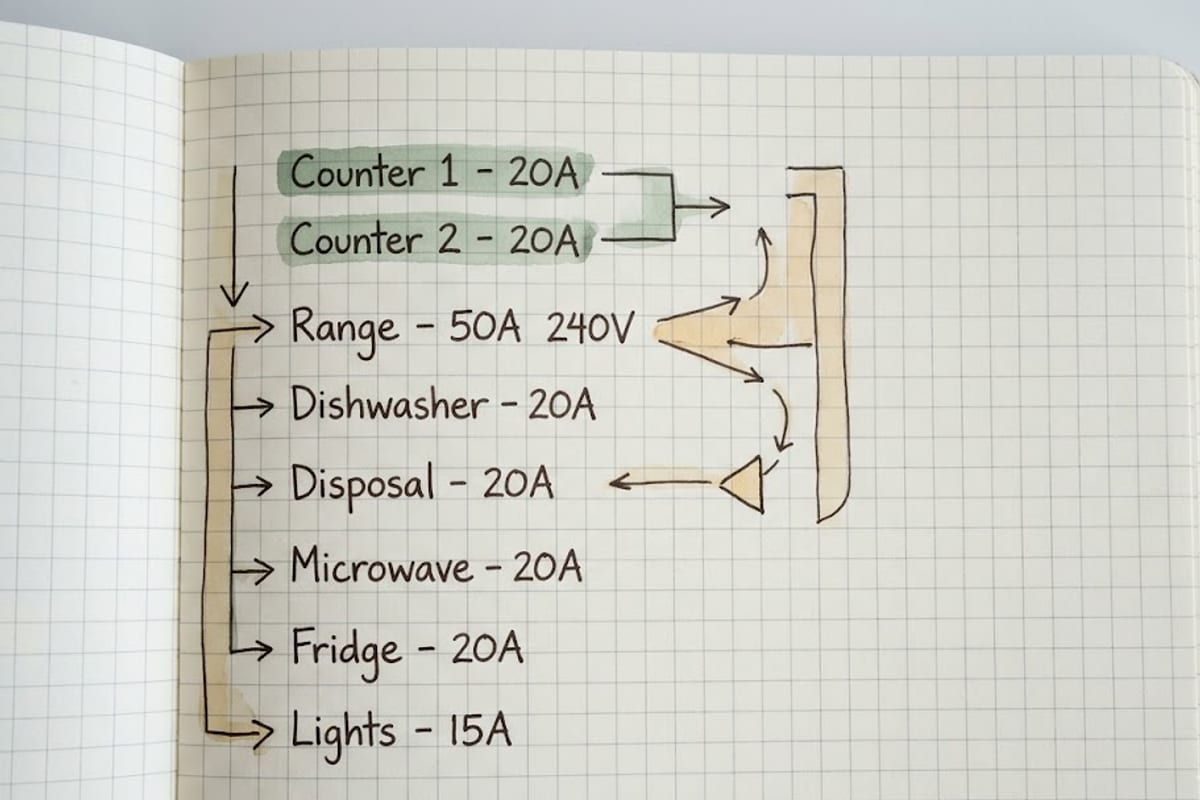
NEC 210.11(C)(1) requires at least two 20 amp small-appliance branch circuits for a dwelling's kitchen, pantry, breakfast room and dining room receptacles. Under 210.52(B), the countertop receptacles must be served by at least two of those circuits, and those circuits cannot serve other outlets such as lighting or a range hood.
The reason is load. A toaster, a kettle, a coffee maker and a microwave each draw 7 to 13 amps. Two of them on one 20 amp circuit trips the breaker. Two separate countertop circuits let two high-draw appliances run at once.
A kitchen can have more than two, and many remodels install three or four when the counter is long or has an appliance garage.
Countertop receptacle spacing
Under 210.52(C):
- A receptacle is required for every wall countertop space 12 inches wide or wider.
- Receptacles must be placed so no point along the wall line is more than 24 inches, measured horizontally, from a receptacle. In practice that means receptacles no more than 48 inches apart, with one within 24 inches of each end of the counter.
- Countertop receptacles can be up to 20 inches above the counter in the 2023 NEC.
- Receptacles installed face-up in the countertop surface are only allowed with devices listed for that use.
A counter broken by a range, sink or refrigerator counts as separate spaces, and each needs its own receptacle coverage.
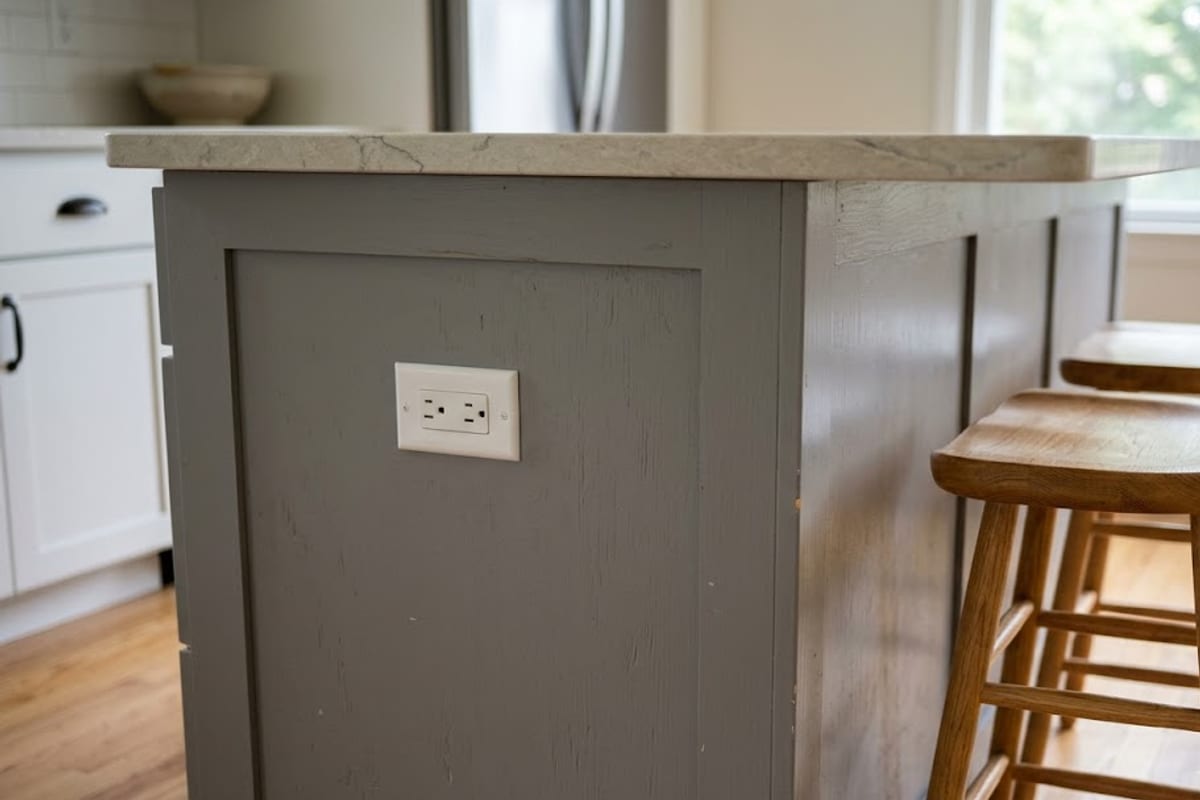
Islands and peninsulas. The 2023 NEC stopped requiring a receptacle on islands and peninsulas. If one is not installed, provisions for adding one later must be made, usually a junction box and a path for the wire. If one is installed, it goes on the countertop or on the side of the island within the height limit.
Appliance circuits
These are the common appliance circuits. The exact size comes from the appliance's nameplate and installation instructions.
| Appliance | Typical circuit | Notes |
|---|---|---|
| Electric range or induction range | 40 or 50 A, 240 V | Size by the nameplate kW and NEC 220.55 |
| Wall oven | 30 to 40 A, 240 V | Separate from a cooktop if both installed |
| Cooktop | 30 to 50 A, 240 V | Induction often at the upper end |
| Dishwasher | 15 or 20 A, 120 V | GFCI required by 210.8(D) |
| Disposal | 15 or 20 A, 120 V | Often shared with dishwasher only if instructions allow |
| Over-range microwave | 20 A, 120 V | Most manufacturers require a dedicated circuit |
| Refrigerator | 15 or 20 A, 120 V | Individual circuit allowed, not required |
| Lighting | 15 A, 120 V | Cannot be on the small-appliance circuits |
Refrigerator. The NEC does not require a dedicated refrigerator circuit, but it allows one: an individual 15 amp or larger circuit can serve the refrigerator instead of the small-appliance circuits. Many electricians install one so a tripped countertop circuit does not shut off the refrigerator.
Dishwasher and disposal. Some manufacturers allow the two to share a 20 amp circuit, and some local codes require separate circuits. Follow the instructions and the local rule.
See dedicated circuits for the same question across the whole house.
GFCI and AFCI in the kitchen
Under the 2023 NEC:
- GFCI. All 125 through 250 volt receptacles in a kitchen need GFCI protection, not only the countertop ones. That includes the refrigerator receptacle and, on newer installations, the range receptacle. The dishwasher needs GFCI protection whether cord-connected or hardwired.
- AFCI. All 120 volt, 15 and 20 amp circuits in a kitchen need AFCI protection.
The usual way to meet both on one circuit is a dual-function AFCI/GFCI breaker. A 20 amp single-pole dual-function breaker lists for about $80 at retail, so a kitchen with five such circuits adds roughly $400 in breakers before labor. See AFCI and GFCI requirements.
Why kitchen breakers keep tripping
In older kitchens the common causes are:
- Too few countertop circuits. One circuit serving the whole counter, sometimes shared with the dining room or the refrigerator. Running a toaster and a kettle together exceeds 20 amps.
- A 15 amp circuit. Older kitchens were often wired with 14 AWG wire on 15 amp breakers. Replacing the breaker with a 20 amp one is not allowed on 14 AWG wire; the circuit has to be rewired with 12 AWG.
- GFCI trips from old appliances or from moisture in a receptacle near the sink.
- AFCI trips from shared neutrals or from appliances with motors, such as some older mixers and refrigerators.
The fix for overload is more circuits, not a larger breaker. For tripping from GFCI or AFCI devices, see the nuisance tripping section of AFCI and GFCI requirements.
Example: laying out a 12 foot counter
Take an L-shaped kitchen with a 12 foot counter along one wall, broken by a sink, and a 6 foot counter on the return wall ending at a range.
On the 12 foot wall, the sink splits the counter into a 5 foot section and a 6 foot section. Each needs a receptacle within 24 inches of each end and no more than 48 inches between receptacles, so each section gets two receptacles. Receptacles within 6 feet of the sink need GFCI protection, but under the 2023 NEC every kitchen receptacle does anyway.
On the 6 foot return, two receptacles cover the run. The range sits on its own 50 amp circuit. That is six countertop receptacles, which the two required 20 amp circuits can serve by alternating them, so adjacent receptacles are on different circuits and a toaster and kettle side by side do not share one.
Add the dishwasher, disposal, microwave and refrigerator circuits and the lighting, and this kitchen has eight circuits.
Induction ranges
Induction ranges have become common in remodels. A typical 30 inch freestanding induction range draws about the same as an electric range and is usually installed on a 40 or 50 amp, 240 volt circuit, per the manufacturer's instructions. Some 120 volt induction ranges with built-in batteries are now sold for kitchens without a 240 volt circuit, and they plug into a standard receptacle. Check the installation manual before assuming the existing circuit will do.
Remodels and panel capacity
A kitchen remodel with a permit generally has to bring the kitchen's new or altered circuits up to current code. That often means adding two or three circuits, and it can be the moment a full panel runs out of spaces. Options include a larger panel, a subpanel, or tandem breakers where the panel allows them. See what to do when a panel is full.
Switching from gas to an electric or induction range adds a 40 or 50 amp, 240 volt circuit and adds to the service load. On a 100 amp service, that can tip a load calculation into needing an upgrade. See do I need 200 amp service.
Who does this
Adding kitchen circuits means working in the panel and running new cable through walls. It needs a permit in nearly every jurisdiction, and in many it must be done by a licensed electrician. A homeowner can plan the layout: where appliances go, how long each counter run is, and whether the island needs a receptacle.
FAQ
How many circuits does a kitchen need? At least two 20 amp countertop circuits, plus one for each major appliance that needs its own. Seven to nine is typical for a kitchen with electric cooking.
Can kitchen lights be on the countertop circuit? No. The small-appliance circuits cannot serve lighting outlets.
Does a microwave need its own circuit? An over-range or built-in microwave usually does, per its installation instructions. A countertop microwave plugs into a countertop circuit.
Is 12 gauge wire required in a kitchen? For the 20 amp small-appliance circuits, yes, 12 AWG copper. See wire size by circuit amps.