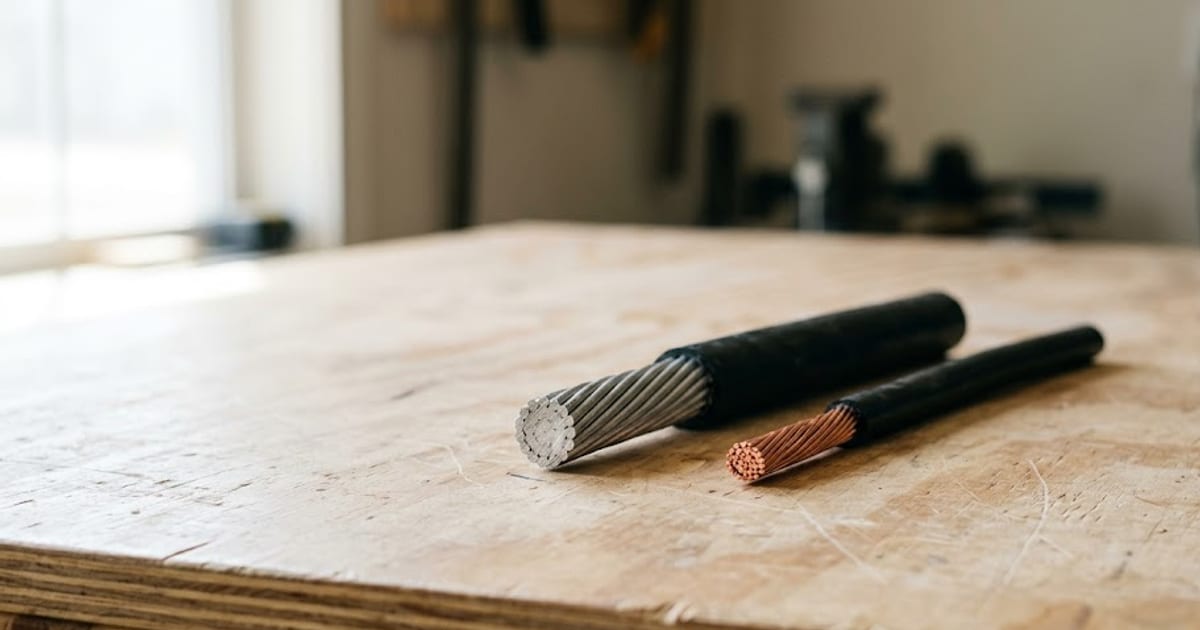
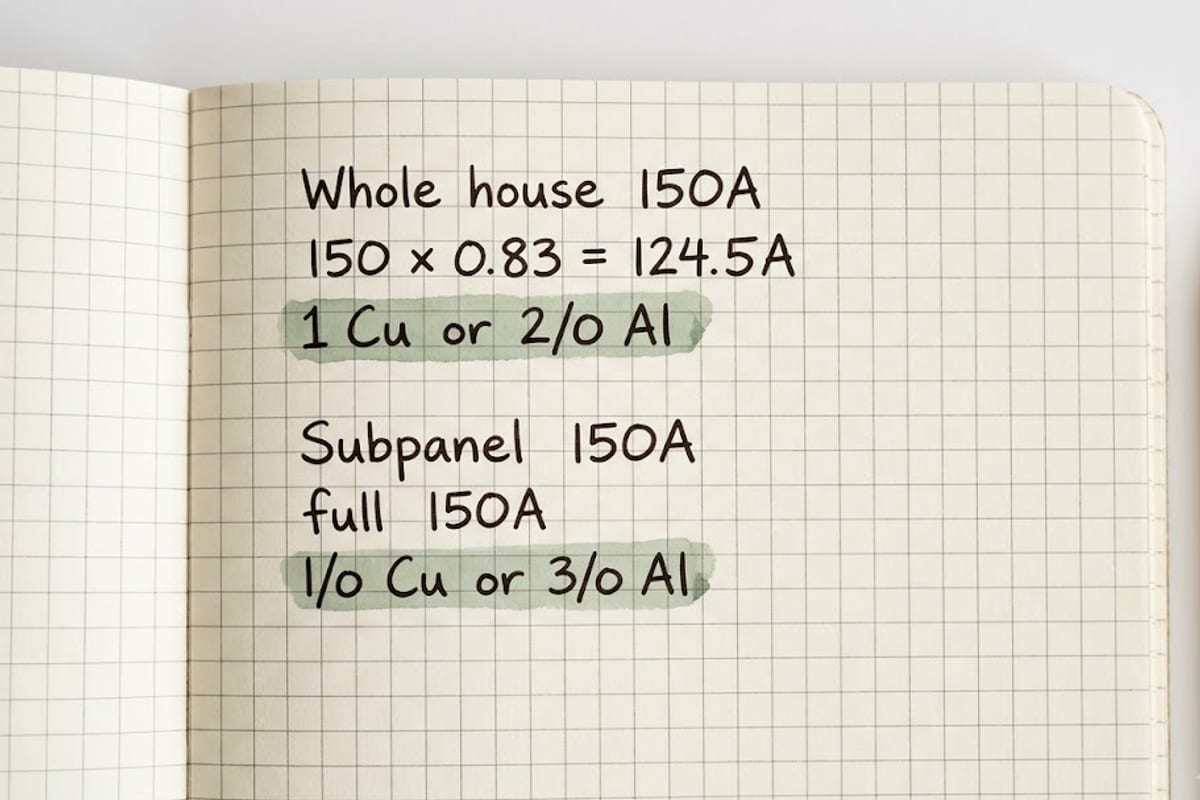
For a 150 amp service that feeds the whole house, the usual conductor size is 1 AWG copper or 2/0 aluminum. For a 150 amp subpanel that feeds only part of the house, a garage or a shop, the usual size is 1/0 copper or 3/0 aluminum. The difference comes from one rule in the National Electrical Code, and using the smaller size in the wrong place is one of the most common wiring mistakes in subpanel work.
Both answers assume 75°C rated terminals, which is standard on residential panels and breakers of this size, and a run short enough that voltage drop is not the limit. Long runs are covered below.
Why the service can use smaller wire
NEC 310.12 lets the service conductors, and a feeder that carries the entire load of a one-family dwelling, be sized at 83% of the service rating. The reasoning is that a whole house never draws its full rating for long, because its loads are diverse.
For 150 amps: 150 × 0.83 = 124.5 amps. In NEC Table 310.16 at 75°C:
- 1 AWG copper is rated 130 amps.
- 2/0 aluminum is rated 135 amps.
Both clear 124.5 amps. Table 310.12 in the 2020 NEC lists the same result directly: a 150 amp service uses 1 AWG copper or 2/0 aluminum. The table applies only when no temperature correction or conduit fill adjustment is needed, for example a service run through a hot attic or bundled with other conductors.
Why a subpanel needs larger wire
The 83% allowance only applies to conductors that carry the whole dwelling's load. A feeder to a subpanel carries some loads, not all, so it must be sized at the full rating of its breaker using Table 310.16.
For a 150 amp breaker at 75°C:
- 1/0 copper is rated 150 amps.
- 3/0 aluminum is rated 155 amps.
There is a second path through NEC 240.4(B). When a conductor's ampacity does not match a standard breaker size, the next standard breaker size up is allowed, as long as the circuit does not supply multiple receptacles for cord-and-plug loads and the calculated load does not exceed the conductor's ampacity. Under that rule, 2/0 aluminum (135 amps) can be protected by a 150 amp breaker. Many electricians use it for garage subpanels. It is only correct if the load calculation for that subpanel stays at or under 135 amps.
A detached garage is not a dwelling, so the 83% rule never applies to its feeder, even if the garage has living space above it.
Quick table
| What the wire feeds | Copper | Aluminum | Rule |
|---|---|---|---|
| 150 A service or whole-house feeder | 1 AWG | 2/0 | 310.12, 83% |
| 150 A subpanel, full rating | 1/0 | 3/0 | Table 310.16, 75°C |
| 150 A subpanel, load ≤ 135 A | 1 AWG (130 A) | 2/0 (135 A) | 240.4(B), next size up |
| Equipment grounding conductor, 150 A feeder | 6 AWG | 4 AWG | Table 250.122 |
Our wire size calculator for a 150 amp breaker gives the conductor for a given length and material, with voltage drop included.
Long runs and voltage drop
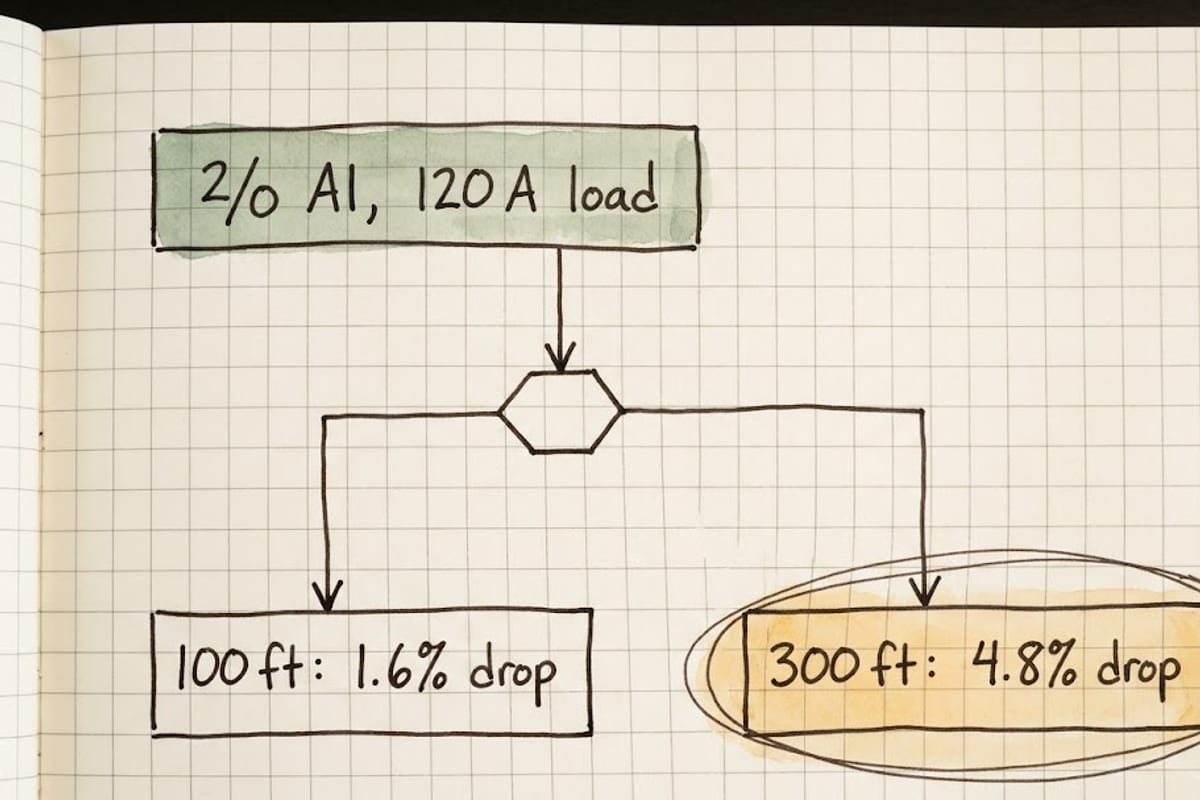
Ampacity tells you the wire will not overheat. It does not tell you how much voltage is lost on the way. The NEC's informational notes suggest keeping feeder voltage drop to about 3%, and 5% total to the farthest outlet. The notes are not enforceable code, but they are the target most electricians design to.
Voltage drop depends on the current actually drawn, not on the breaker size. The table below assumes a 120 amp load, which is a heavy but realistic load for a 150 amp subpanel, on a 240 volt feeder.
| Conductor | 50 ft | 100 ft | 150 ft | 200 ft | 300 ft |
|---|---|---|---|---|---|
| 1 AWG copper | 0.8% | 1.5% | 2.3% | 3.1% | 4.6% |
| 1/0 copper | 0.6% | 1.2% | 1.8% | 2.4% | 3.7% |
| 2/0 aluminum | 0.8% | 1.6% | 2.4% | 3.2% | 4.8% |
| 3/0 aluminum | 0.6% | 1.3% | 1.9% | 2.5% | 3.8% |
| 4/0 aluminum | 0.5% | 1.0% | 1.5% | 2.0% | 3.0% |
Calculated with the standard formula VD = 2 × K × I × L ÷ circular mils, K = 12.9 for copper and 21.2 for aluminum.
Past about 150 feet, the 2/0 aluminum that satisfies the code starts to exceed 3%. For a shop 250 feet from the house, 4/0 aluminum is a common choice even though 3/0 would carry the current. See voltage drop on long runs.
Worked example: a shop 180 feet from the house
A detached shop will have a 150 amp subpanel fed from a 150 amp breaker in the house panel. The subpanel's load calculation comes to 110 amps. The run is 180 feet underground in PVC conduit.
Ampacity: the feeder does not carry the whole house, so the 83% rule does not apply. At full breaker rating, 3/0 aluminum (155 amps) qualifies. Through 240.4(B), 2/0 aluminum (135 amps) would also be allowed, because the calculated load of 110 amps is under 135.
Voltage drop at the calculated load of 110 amps: 2/0 aluminum gives about 2.6% at 180 feet, and 3/0 about 2.1%. Both meet a 3% target. At a heavy 130 amp load, 2/0 rises to about 3.1%.
Choice: 3/0 aluminum for the hots and neutral, with a 4 AWG aluminum or 6 AWG copper equipment grounding conductor, and a ground rod at the shop. It costs a little more than 2/0 and leaves margin for a future welder or heat pump.
Copper or aluminum
For conductors of this size, aluminum is standard for services and feeders. Utilities use it, and modern AA-8000 series aluminum alloy terminated in lugs rated for aluminum is reliable. It costs much less than copper per foot of equivalent ampacity.
The problems with aluminum wiring that insurers ask about involve small branch circuit wire from the 1960s and 1970s, not large feeders. For a 150 amp feeder, the decision is mostly about price, conduit size, and how easily the larger aluminum bends into the panel.
Whatever the material, terminations must be torqued to the value on the panel label. Loose lugs, not the wire, cause most feeder failures.
Other parts of the feeder
Four wires to a subpanel. A feeder to a subpanel, including one in a detached building, needs two hot conductors, a neutral, and an equipment grounding conductor. In the subpanel, the neutral and ground are kept separate. See subpanel neutral and ground.
Ground rods at a detached building. A separate building supplied by a feeder needs its own grounding electrode, usually one or two ground rods, bonded to the equipment grounding conductor. See the grounding electrode system.
Grounding electrode conductor for the service. For a 150 amp service using 1 AWG copper or 2/0 aluminum, NEC Table 250.66 calls for a 6 AWG copper grounding electrode conductor.
Conduit size. Four conductors of this size need a larger conduit than most people expect. Ask for the fill calculation rather than choosing conduit by eye.
Who should do this
Sizing the conductor is the easy part. Installing a service or a feeder means working at the service equipment, making up lugs at high current, and often working near conductors that cannot be de-energized without the utility. In most jurisdictions it needs a permit and an inspection, and in many it must be done by a licensed electrician. Use these numbers to check a quote or a plan, not as installation instructions.
FAQ
What size wire for a 150 amp panel? It depends on what feeds it. As the main service panel for the house: 1 AWG copper or 2/0 aluminum. As a subpanel: 1/0 copper or 3/0 aluminum at full rating.
Can I use 2/0 aluminum on a 150 amp subpanel breaker? Only through NEC 240.4(B), when the subpanel's calculated load is 135 amps or less and the circuit does not feed multiple cord-and-plug receptacles. Many inspectors accept it for garages. Check with yours.
What size wire for 150 amps at 200 feet? For a subpanel, 3/0 aluminum carries the current and keeps drop near 2.5% at a 120 amp load. 4/0 aluminum brings it to about 2%.
Is SER cable allowed? Yes, type SE style R cable is commonly used for feeders inside buildings. Its ampacity follows the same Table 310.16 columns, with limits where it runs through insulation.