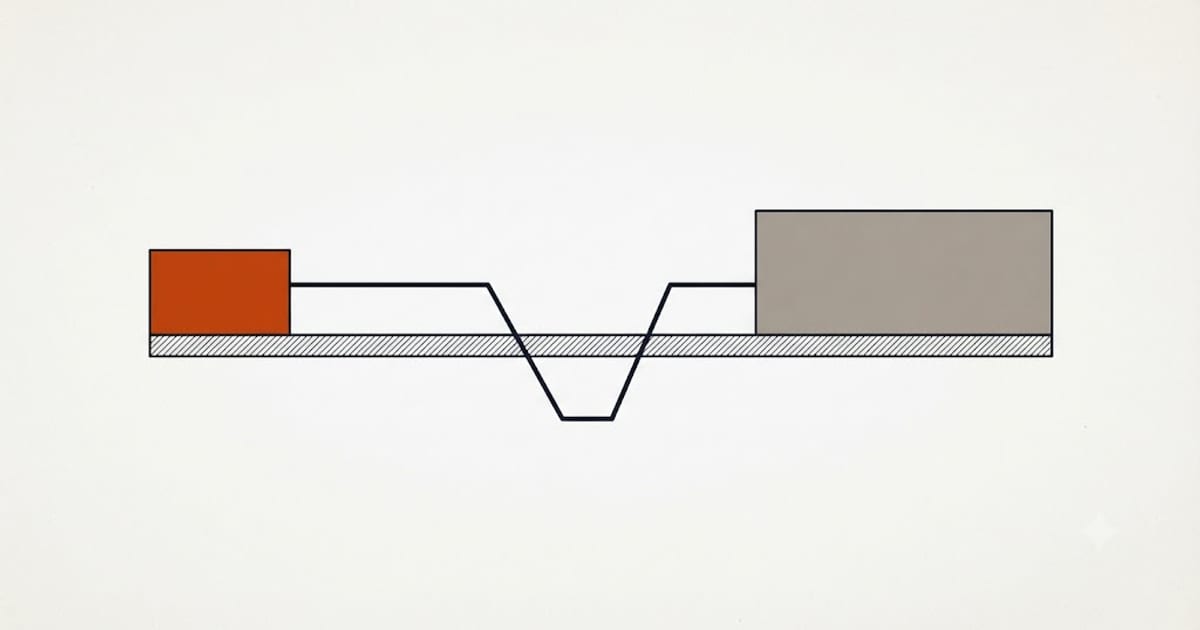
Two different rules choose the conductor for a long run, and over any real distance they give different answers.
Ampacity asks whether the wire can carry the current without overheating. That is the table everyone looks at, and it is about safety.
Voltage drop asks whether enough voltage survives the journey to run the equipment properly. That is about whether anything works, and past about 50 feet it is usually the binding constraint.
The arithmetic
For a single-phase run:
Voltage drop = 2 × K × L × I ÷ CM
where K is 12.9 for copper, L is the one-way length in feet, I is the current in amps, and CM is the conductor's area in circular mils.
The commonly used target is 3% on a feeder and 5% total including the branch circuits it feeds. On a 240-volt feeder, 3% is 7.2 volts.
What that means for a 60 A feeder to a garage
| One-way run | Copper size by ampacity | Copper size by 3% drop |
|---|---|---|
| 25 ft | 6 AWG | 6 AWG |
| 50 ft | 6 AWG | 6 AWG |
| 100 ft | 6 AWG | 4 AWG |
| 150 ft | 6 AWG | 2 AWG |
| 200 ft | 6 AWG | 1 AWG |
The ampacity column does not move. The voltage drop column moves two sizes across a distance that is entirely ordinary for a back garden.
Aluminium is roughly one size larger again for the same drop, and it is often the cheaper answer on a long run despite that — direct-burial aluminium feeder cable is substantially less expensive per foot than copper, and the terminations are entirely manageable with the right connectors and antioxidant compound.
Why it matters more than it sounds
Ten volts sounds trivial. It is not, for motors.
A motor is a roughly constant-power device: give it less voltage and it draws more current to do the same work. More current in the same wire produces more drop, which produces more current. The motor runs hot, starts sluggishly, and its life shortens. A table saw that bogs down in a cut, or a compressor that struggles to start in cold weather, is very often a voltage drop problem being blamed on the tool.
Resistive loads — heaters, incandescent lighting — simply produce less output, which is annoying rather than damaging. Electronics with switching supplies mostly do not care. Motors care a great deal, and a garage is full of motors.
The requirements specific to a detached building
A grounding electrode at the garage. A detached structure needs its own grounding electrode system — typically one or two ground rods — bonded to the subpanel's ground bar. The equipment grounding conductor from the house does not remove this requirement.
Four wires, not three. Older installations ran three conductors and bonded neutral to ground at the outbuilding. That is no longer permitted. Current code requires four wires — two hot, one neutral, one equipment ground — with the neutral bar isolated from the enclosure at the subpanel. The bonding screw or strap that ships installed in the panel must be removed.
This is the single most common error in DIY outbuilding feeders, and it matters: with neutral and ground bonded at both ends, normal neutral current flows on the ground path and on anything else conductive between the buildings.
A disconnecting means at the building. The subpanel with a main breaker satisfies it in most cases.
Burial depth. It varies with method and with local amendment. Direct-burial cable, conduit, and rigid metal conduit all have different minimums, and the depth is measured to the top of the raceway.
Skip the neutral only if you are certain. A 240-volt-only feed to a garage with no 120-volt circuits does not need a neutral — but every garage eventually gets lights and receptacles, and adding a neutral later means digging the trench again. Run it.
Sizing the feeder itself
Size for what the garage will actually be, not for what is in it today. The trench is the expensive part, and the difference between 60 A and 100 A of conductor is small against digging it twice.
A reasonable default: 60 A for lighting, receptacles and hand tools. 100 A if there will be a welder, a compressor and a car lift, or if an EV charger might live out there.
Whatever is chosen, calculate the drop at that ampacity over the actual measured run — not the straight-line distance on a map, but the route the trench will take, including the rise up both walls.