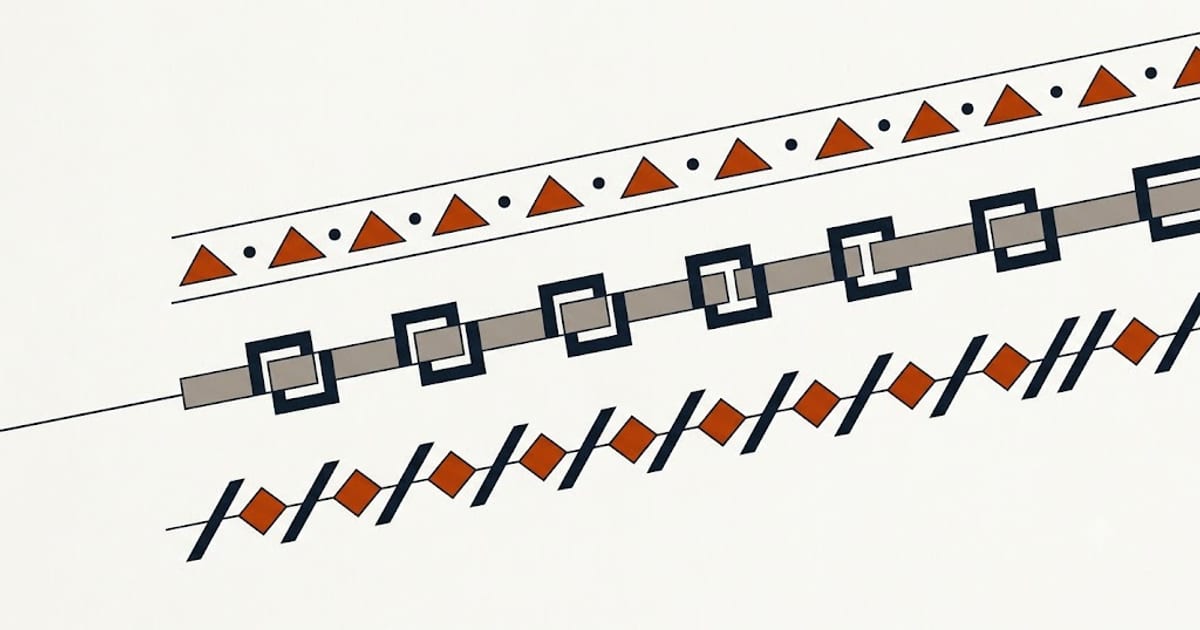
Three types of older residential wiring come up repeatedly, and they present different problems.
Knob and tube
Roughly 1880s to 1940s. Individual conductors run through porcelain tubes where they pass through framing and supported on porcelain knobs, with the hot and neutral run separately and spaced apart.
The problems: no equipment grounding conductor, brittle insulation after a century, and — the important one — it is designed to dissipate heat into open air. Burying it in insulation is the specific hazard, and it is what happened to a great many houses when attics were insulated in the 1970s.
It is also almost always been extended and modified by successive owners, and the modifications are usually worse than the original work.
Insurance: many insurers decline or surcharge, and some require replacement as a condition.
Cloth-insulated cable
Roughly 1930s to 1960s. Early sheathed cable with rubber and cloth insulation, sometimes with no ground and sometimes with a reduced-size ground.
The problems: the rubber insulation hardens and cracks with age and heat, particularly at terminations where it has been warm for decades. The result is bare conductor at the device.
Frequently the insulation is sound in the middle of a run and failed at both ends, which is why an assessment is done at the boxes.
Aluminium branch wiring
Roughly 1965 to 1973, for 15 and 20 amp branch circuits.
The problem is at the connections. Aluminium expands and contracts more than copper, oxidises to a resistive layer, and creeps under a terminal screw. The connection loosens, heats, and can arc.
The recognised remedies are specific: COPALUM crimps, applied by a licensed installer with the proprietary tool, or listed AlumiConn connectors at every device.
Replacing devices with CO/ALR rated ones is a partial improvement. Ordinary wire nuts are not a repair, and antioxidant paste alone is not either.
Note that large aluminium conductors for services and feeders are a completely different matter and are standard in current construction.
What each costs to address
Knob and tube: rewiring is the only real answer, and the cost depends entirely on access — an unfinished attic and basement in a two-storey house is far cheaper than a plastered house with finished spaces.
Cloth cable: sometimes the terminations can be made up in a box where the insulation is sound, extending with new cable. More often the age argues for rewiring the circuits that matter.
Aluminium: connector remediation at every device is far cheaper than rewiring and is the accepted solution. It is a per-connection cost, so it scales with the number of devices rather than the length of the runs.
Doing it in stages
A full rewire is disruptive and expensive. A staged approach is legitimate:
Kitchen and bathrooms first, where GFCI and dedicated circuits matter most.
Bedrooms next, where AFCI protection addresses the arcing hazard directly.
Then the rest, as rooms are decorated or opened for other work.
Each stage adds circuits to the panel, so the panel and its capacity are the first thing to establish rather than the last.
What to have done first
An assessment: open a sample of boxes, look at the insulation at terminations, check for grounds, and check what has been added over the years.
That inspection costs a fraction of any of the remedies and it distinguishes wiring that is old from wiring that is failing — which are not the same thing, and only one of them needs a cheque.
Insulation and knob and tube together
The specific rule worth knowing: thermal insulation must not be installed in contact with knob and tube wiring, because the wiring relies on air circulation to dissipate heat.
An attic insulated over live knob and tube is a common finding in houses weatherised in the 1970s and since, and it is one of the few situations where two separate improvements combine into a hazard.
Where insulation is planned in a house that still has it, the wiring in that space is replaced first. That constraint frequently determines the order of a whole renovation.