A service upgrade replaces the electrical service from the utility's connection point to the main panel. That means the meter socket, the mast or underground conduit, the service entrance conductors, the grounding electrode system and the panel, sized for a higher rating, usually going from 100 to 200 amps. The job has three parties: the electrician, the local inspector, and the utility. The electrician's work usually takes one day, while the utility and inspection schedule decide how long the whole process takes.
A typical 200 amp service upgrade costs $1,800 to $4,000 on our state pages, around $2,800 nationally. For the line items, see the cost to upgrade from 100 to 200 amp service.
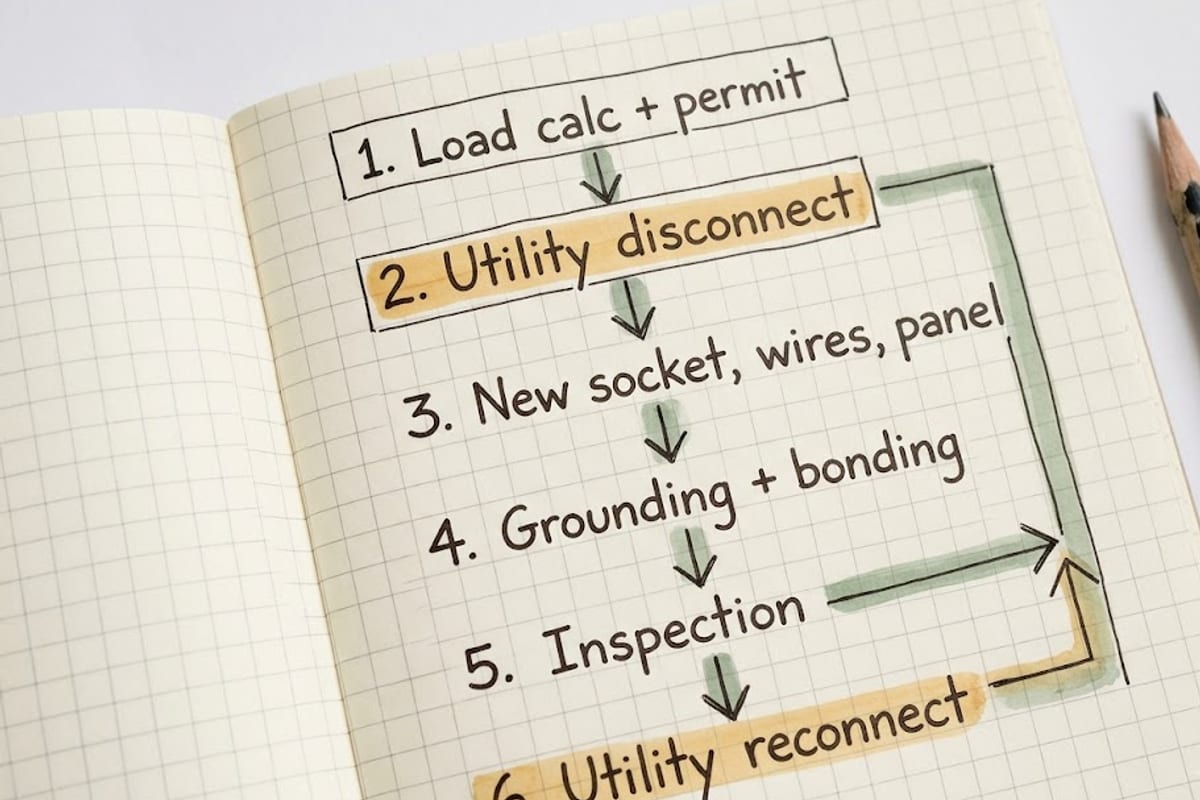
Step 1: Load calculation and permit
A good contractor starts by confirming the upgrade is needed. A load calculation under NEC Article 220 counts the square footage, the fixed appliances, and the larger of heating or cooling, with demand factors. If a 100 amp house calculates at 85 amps, a load management device may be cheaper than a new service. See do I need 200 amp service.
The electrician then pulls a permit from the city or county. Many utilities also need their own service request before they will schedule the disconnect, and some require a site visit to confirm the meter location. For larger services, and for some underground services, the utility may need to review its transformer or lateral.
Step 2: Utility disconnect
Nothing on the line side of the main breaker can be switched off by the homeowner or the electrician. The service conductors from the utility to the main breaker have no overcurrent protection and stay energized until the utility disconnects them at the pole, at the transformer, or by pulling the meter and cutting the drop.
On the work day, the utility crew disconnects the service, usually in the morning. The house is without power from this point until the reconnect.
Step 3: New meter socket, conductors and panel
The electrician removes the old equipment and installs the new:
- Meter socket rated for the new service and approved by the utility. When the service disconnect is outside, this can be a meter-main. See meter base with disconnect.
- Mast and weatherhead on an overhead service, tall enough for the required clearances. On an underground service, conduit and conductors from the utility's point of connection to the socket.
- Service entrance conductors. For 200 amps these are typically 2/0 copper or 4/0 aluminum, using the NEC 310.12 allowance of 83% of the rating for dwelling services.
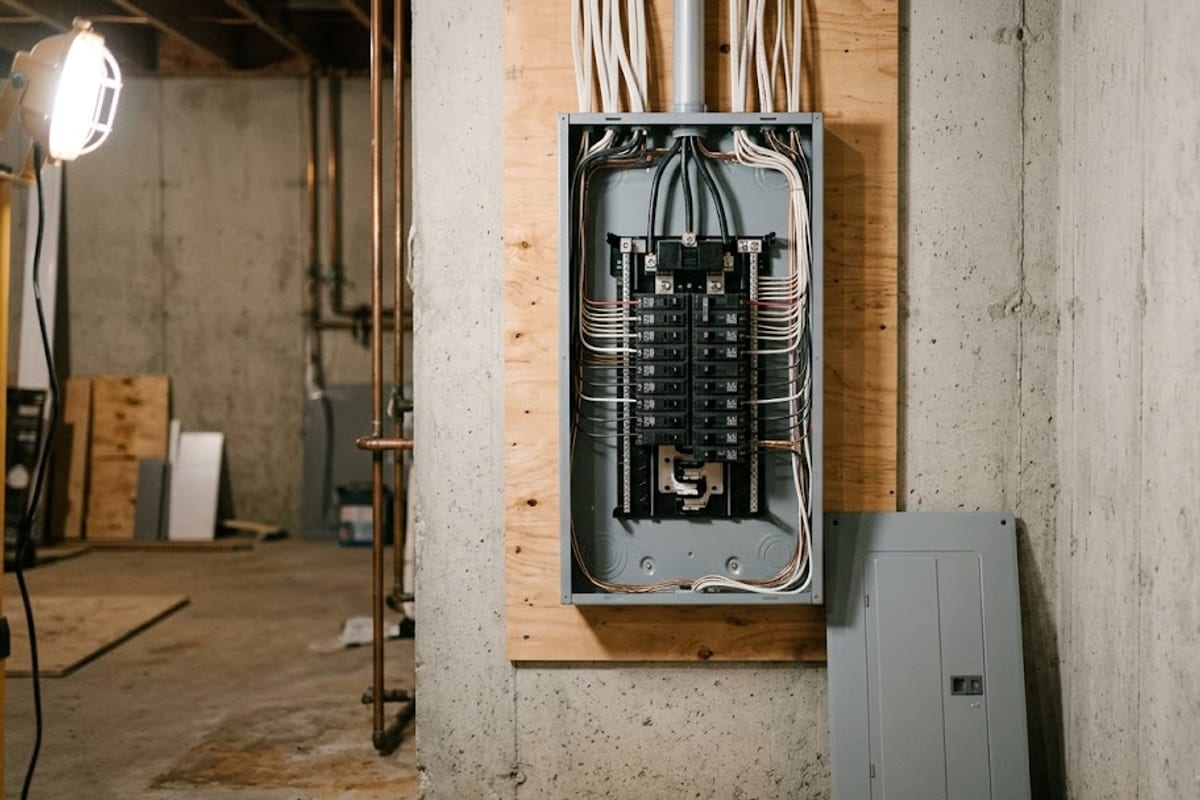
- The panel, with a main breaker at the new rating and enough spaces for the existing circuits and some growth.
- Branch circuits reconnected to new breakers, with AFCI and GFCI protection as the local inspector requires.
Step 4: Grounding and bonding
The grounding electrode system is brought up to current code under NEC Article 250. In most houses that means:
- Two ground rods at least 6 feet apart, unless one rod is shown to meet the resistance requirement.
- A connection to a metal underground water pipe where one exists, bonded near where it enters the house.
- Bonding of the metal gas piping and other metal piping systems.
- An intersystem bonding termination outside, where cable, phone and satellite grounds connect.
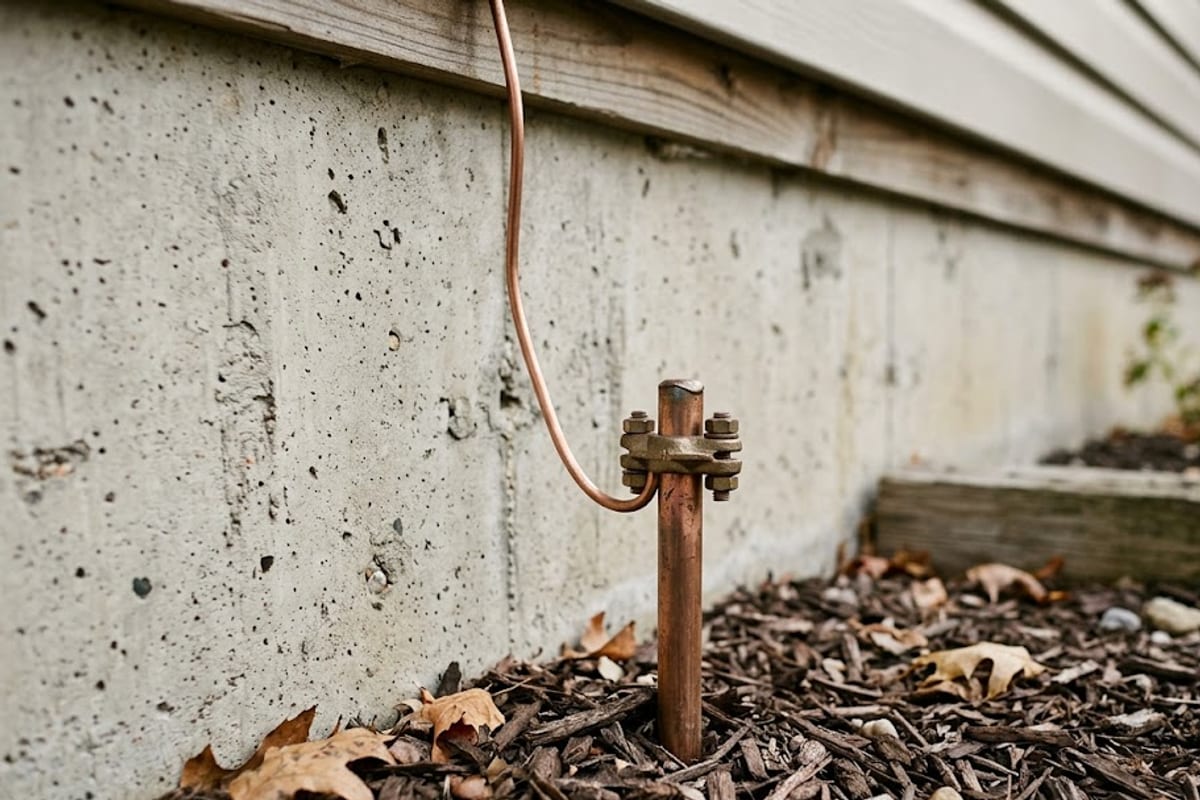
See the grounding electrode system for the details.
Step 5: Current code items
Replacing service equipment triggers the current rules for services. Under the 2020 and 2023 NEC, that includes:
- Surge protective device (230.67) at the service equipment.
- Outdoor emergency disconnect (230.85) for one- and two-family dwellings.
- Working space in front of the panel (110.26): generally 30 inches wide, 36 inches deep, and 6.5 feet high, clear of storage.
- Panel location: not in a clothes closet or a bathroom.
If the old panel is in a prohibited spot, the new one moves, and every circuit is extended to the new location. See panel location and clearances.
Step 6: Inspection and reconnect
The inspector checks the service equipment, grounding, and the panel before the utility reconnects. In many cities the inspector coordinates directly with the utility. Once the inspection passes, the utility reconnects the drop or lateral and installs the meter, and the power comes back.
How long the house is without power depends on how those appointments line up:
- Same day. The utility disconnects in the morning, the electrician finishes by early afternoon, the inspector comes by mid-afternoon, and the utility reconnects before evening. This is common where utilities and inspectors schedule service changes routinely.
- Next day or later. Where the inspector or utility cannot come the same day, the house waits. Some electricians set up temporary power for the refrigerator and a few lights, if the utility allows it.
Ask the contractor for their sequence before signing. "A one day job" and "one day without power" are different promises.
What commonly adds cost
Moving the meter. Utilities set rules for the meter location and height. An old meter on a back porch or inside a fenced yard may have to move.
A new utility drop or lateral. For 200 amps most utilities reuse the existing drop. Some replace it at their cost, some bill the customer.
Old wiring at the panel. Cloth-insulated cables, undersized conductors, overloaded splices, or aluminum branch circuits found at the old panel must be corrected where they connect to the new one.
Wall and siding repair where the old mast or cable entered.
AFCI and GFCI breakers. When circuits are reconnected, many jurisdictions require them to meet current protection rules. A 20 amp dual-function breaker lists for about $80 at retail.
Overhead or underground
Most service upgrades keep the same type of service. An overhead service gets a new mast, and the utility reconnects the existing or a new drop. An underground service gets new conductors from the utility's connection point. Converting from overhead to underground is a separate, larger project that a capacity upgrade does not require. See overhead vs underground service.
Doing other work at the same time
The panel is open and the power is already off, which makes it the cheapest time to add:
- A circuit for a future EV charger. See EV charger electrical requirements.
- A subpanel for a garage, shop or basement.
- A generator inlet with an interlock or a transfer switch.
- Dedicated circuits for a heat pump or an induction range. See dedicated circuits.
What the homeowner can prepare
Clear a path to the meter and the panel, and at least 3 feet in front of the panel. Move anything stored under the mast or in the way of the utility truck. Unplug computers and sensitive electronics before the disconnect. Plan for the refrigerator and freezer to be off for the day, and for any medical equipment that needs power.
Who does this
A service upgrade is licensed, permitted work in every state. It involves the utility's conductors, which can deliver very high fault current, and it requires coordination with the utility and an inspection before reconnection. A homeowner can prepare by clearing access to the meter and panel and moving stored items away from the work area.
FAQ
How long does a service upgrade take? The installation is usually one day. From quote to finished job, two to six weeks is common, mostly waiting for the permit and the utility's schedule.
Can the power stay on during the upgrade? No. The utility disconnects the service for the work.
Do I need to be home? Usually someone needs to provide access to the panel and meter and be present for the inspection. Ask the electrician what they need.
Does the utility charge for disconnect and reconnect? Many do not for a standard residential upgrade. Some charge a fee or bill for a new drop. Check your utility's service manual.